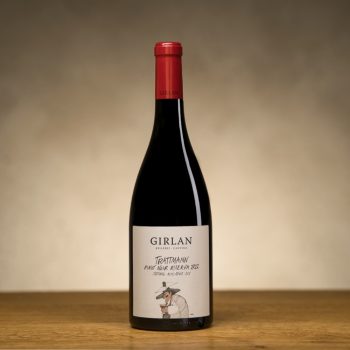
Pinot Noir can be elegant and engaging like few other wines in the world, it “captures” its terroir and returns it in the glass only if well interpreted and respected, and must be planted and trained in specific sites that are able to convey its multifaceted personality. For most winemakers around the world Pinot Noir is one of the most exciting challenges to take. It is no coincidence, therefore, that it has found itself for many decades in the vineyards of Cantina Girlan, Trentino Alto Adige.
Cantina Girlan was founded in 1923 in an ancient farmstead from the 16th century. Back then 24 winegrowers laid the foundation stones of what was later to become the winery we see today. The walls, steeped in ancient tradition, and the labyrinthine corridors of the cellar harbour the secrets of state-of-the-art winemaking technology and hold the ideal conditions for ageing our wines.
Today, about 200 greatly committed and motivated winegrowers and their families farm an area covering about 230 hectares of vineyards in the best production areas of Oltradige and Bassa Atesina. The enologist, Gerhard Kofler, keeps in close personal contact with the winegrowers and provides his professional advice during the growing season. This beneficial exchange of expertise sets the foundations for producing highest quality wines.
 The research method
This in-depth research that Cantina Girlan has undergone over years, in search of the best sites for the cultivation of Pinot Noir, has led to a detailed analysis of the variety’s behaviour within individual crus, parcel by parcel, through different microvinifications. Here, the difference of their climatic and geological conditions, the orientation of the vineyards and the age of the vines have been carefully considered.
The cru of Girlan has vineyards that extend between 450 and 500 metres above sea level. Its soils are characterized by the presence of morainic deposits on a porphyritic volcanic rock. In the small village of Pinzon, on the other hand, the soils are constituted by a limestone and clay and the vineyards are oriented towards the south-west, at an altitude between 400 and 450 metres above sea level. The cru of Mazon is considered one of Italy’s best sites for the cultivation of Pinot Noir, being its soils rich in clay and limestone. The vineyards are oriented towards west and extend between 360 and 430 metres above sea level.