And so, in Georgia, wine is both an economic asset and source of identity and national pride. You’ll find it everywhere: in designer glassware or homespun pitchers at formal affairs and casual gatherings.
There are nearly 2,000 registered commercial operations bottling 175 million hectoliters of wine annually, according to the national trade agency Wines of Georgia. And yet, that’s hardly the complete story of modern Georgian wine. Many private residents also grow grapes on backyard trellises to make wine for their households, dotting the contemporary landscape with living totems to its evolving heritage.

Flanked by Turkey, Armenia and Azerbaijan, the Black Sea shoreline forms Georgia’s western border, while the snow-capped peaks of the Caucasus Mountains line its northern perimeter with Russia.
Elevation and proximity to various bodies of water create a range of climatic conditions. The western seafront region has humidity, coastal breezes and very little frost, whereas winters are long and cold in the northwestern highlands. The Likhi Range, an interior offshoot of the Caucasus Mountains, bisects Georgia from north to south. It helps to create a quasi-tropical climate in the eastern part of the country, Kakheti, where most commercial wine production takes place.
Viticulture occurs across a range of soils. Most are clay, sand or a combination thereof, but wine grapes are also grown in alluvial, slate, volcanic and limestone soil.
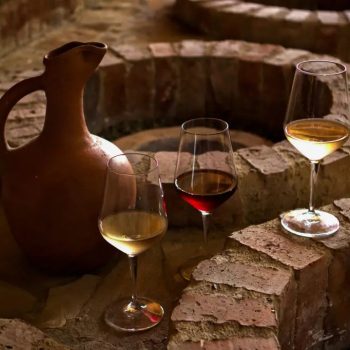
Throughout ensuing millennia, wine has been a means of cultural expression and form of resistance in Georgia. In the Meskheti region, for instance, in the early 18th century, “during the Ottoman rule it was forbidden to grow vines and make wines there, and the locals would replant their vines in the forest so that they would be discovered later,” says Kholodilina.
From 1922-1991, when Georgia was part of the Soviet Union, winemaking was industrialized, family plots fell under governmental control and, according to some sources, 500 indigenous Georgian grape varieties were uprooted in one region.
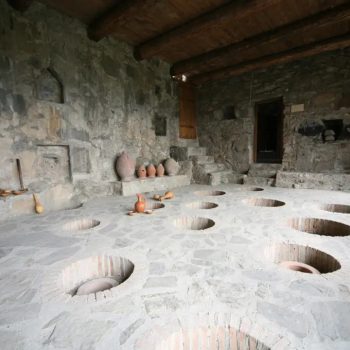
One manner of reclaiming Georgian wine was to reembrace qvevri, the country’s ancient amphora. These clay vessels are made in an array of sizes, and winemakers put everything into them, including the grapes, skins and stems. They seal the qvevri with wax or clay and bury it, eliminating the need for temperature control as the wine ferments. The wine clarifies on its own as the byproducts naturally rise to the top.
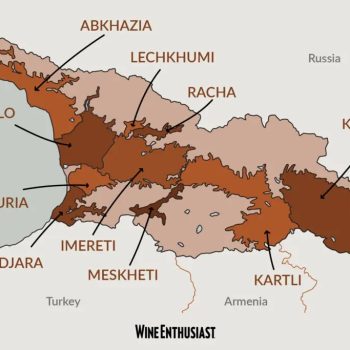
The primary winemaking region is Kakheti, situated in the east at the foothills of the Caucasus. Some 80% of Georgia’s wine production takes place here, Jancis Robinson and Hugh Johnson estimate in The World Atlas of Wine, and the range of bottlings span easy-drinking white wines, full-bodied reds and everything in between, made in European and traditional qvevri methods. There are three main subregions of Kakheti and 18 appellations.
Other prominent PDOs include Shida Kartli and Kvemo Kartli, in central Georgia, which produce what Kholodilina calls “subtler ambers and reds, as well as really interesting sparkling wines.” In western Georgia lies Imereti, a region where winemakers use less skin-contact and more European winemaking techniques. Racha and Lechkhumi, also in the west of the country, produce semisweet red and white wines.
There are more than 500 indigenous grape varieties in Georgia, 40 of which are currently used for commercial viticulture. International varieties like Cabernet Sauvignon and Shiraz comprise just 6% of plantings, says Wines of Georgia.
White wine grapes include Rkatsiteli, which produces crisp bottles ideal for pairing with the country’s exceptional cheese and breads; floral, aromatic Kisi; and Mtsvane Kakhuri, a light-skinned grape that creates medium-bodied wines with complex, minerally flavors. Mtsvane and Rkatsiteli blends are common, too.
The most famous red wine grape is Saperavi, a dark-skinned grape and one of the world’s few with a red interior. It produces ink-colored wines with berry, meaty and spicy notes that can be accented by qvevri aging.
Other red wine grapes include ancient, thin-skinned Dzelshavi, often used in red blends; Mujuretuli, another blending grape in dry and off-dry reds; Kartli’s Shavkapito, used to make full-bodied reds and some sparkling wines; and Otskhanuri Sapere, a tannic variety mostly grown in Imereti.
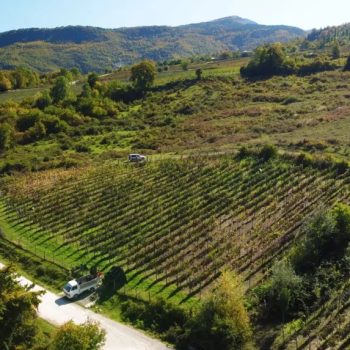
In recent years, “the number of small wineries skyrocketed, and the quality of wine made by them got much better,” says Kholodilina. Plus, contemporary Georgian growers and winemakers “are getting more open to experiments, they travel more, attend fairs, talk to their peers, see what’s up globally and come back home inspired.”
Their bottles are increasingly available, too. Last year, more than 107 million bottles of Georgian wine were exported to 64 countries, up from 92 million exported bottles to 63 countries in 2020.



Leave a comment